Time flies! I can’t believe it’s already been 25 days since the challenge started. I wish I could tell you that I didn’t miss a single day, ticked off every task, and tracked at least 25 hours of Japanese study time. Unfortunately, that’s not quite how real life works.
My updated system
In my first post, I mentioned using Striving to track my study time, and Loop Habit Tracker to tick off the daily tasks I managed to do in a day. I’m still using Loop Habit Tracker, but I’ve replaced Striving with Toggl Track.
Sometime during the second week, I had an annoying issue with Striving that forced me to stop using the app immediately. I forgot to turn off the time tracker, so I had 60 minutes for WaniKani instead of 5. Unfortunately, the only thing you can change in past entries is the tag—not the duration or anything else. It was frustrating, to say the least.
I initially opted for Striving because it was a cute and simple alternative to Forest. But that fiasco made me acknowledge that Striving is pretty rudimentary and does not offer the best user experience, and that I needed a dedicated time tracker. It was time to get back to Toggl Track—something that I’ve used on and off for years. It might seem boring and too “clinical,” but there’s no question that it’s an excellent time-tracking software. I love that it’s easily customizable to suit your needs. It’s also just incredibly clean and intuitive to use.
During the second week, I manually migrated all the past week’s data from Striving to Toggl Track. And over the next few days, I updated my setup and tagging system so it’s easier to see everything at a glance and generate free reports (I didn’t want to spend a single peso just to track my hours).
Summary of changes made
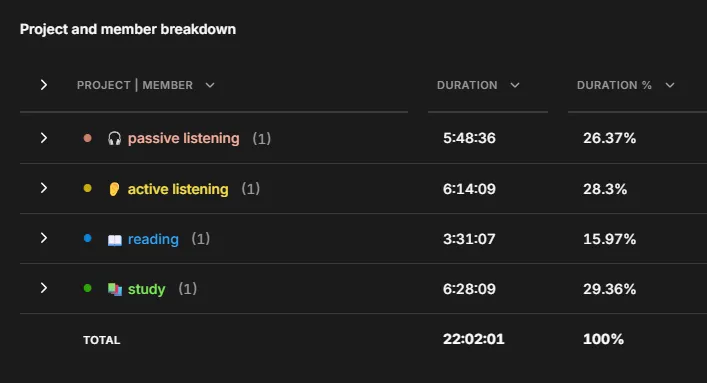
Currently, I use 4 main categories (or “projects” in Toggl Track) when tracking my study time:
- passive listening includes immersion activities, such as watching anime, listening to podcasts while doing something else, or playing videos in the background
- active listening encompasses both podcasts and videos, as long as I’m 100% focused on the content
- study involves using Renshuu or WaniKani, as well as watching grammar-related videos and trying out different apps or websites to review grammar, vocabulary, or kanji
- reading includes reading the transcript of videos and reading short articles or stories in apps.
Breakdown of stats and resources used
Passive listening
The bulk of my listening was listening to podcasts while on the way to the office. I’ve only been listening to The Miku Real Japanese Podcast lately. Maybe I’ll listen to other podcasts moving forward; maybe not. We’ll see.
I recently got back to watching anime. Specifically, I’ve been rewatching Free! since I wanted to be inspired now that I’m taking swimming lessons. At the start, I didn’t track my anime hours; I only started tracking it as passive listening on July 20. I figured I could use the extra hours, especially on days when I can’t dedicate a lot of time to Japanese or simply don’t have the energy to do so.
Active listening
My go-to resources for active listening are Natural Japanese (previously Comprehensible Japanese) and Nihongo no Jikan. These sites share the same philosophy and just make it so easy to consume Japanese content suited to your level. If I wanted to change things up, I’d sometimes watch videos on YouTube.
Reading
During the first week, I mostly used Yomu Yomu and HelloStory for reading. Eventually, I figured it was a lot more straightforward to use the video transcripts on NIJ or Nihongo no Jikan.
Study
My “study” hours mainly come from Renshuu and WaniKani. I briefly explored an app called Glosaire—I absolutely adored the pink aesthetic, and the interface was elegantly designed, but the functionality fell short. It’s a no for me.
Breakdown of tasks and reflections
Task 1: 60 minutes of study
Days completed: 15 out of 25 days
- My “study” hours were usually just the sum of the activities I did on a particular day. Unfortunately, I wasn’t able to dedicate some time to separate 60-minute study sessions.
Task 2: Read for 10 mins
Days completed: 16 out of 25 days
- I struggle the most with being consistent with reading (which is strange, considering how obsessed I am with reading in general). When it’s the only pending task at the end of the day, I tend to skip it. The best approach is to do it first so the hardest thing is immediately out of the way.
- I’ll keep using Natural Japanese and Nihongo no Jikan as my main resources, but I’ll switch to apps now and then to change things up.
Task 3: 1 podcast, episode, or YouTube video
Days completed: 20 out of 25 days
- This task was pretty easy to fulfill, given that I watch or listen to a lot of content.
Task 4: Renshuu
Days completed: 17 out of 25 days
- I’m already on the fourth week, but I haven’t completely caught up with my Renshuu reviews. (My backlog is simply too massive.) I’m getting there, though!
- That said, I haven’t learned new items on Renshuu just yet—I’m focusing on reviews for now. Once I’m all caught up, I’ll get back to regular programming of learning new terms and a couple grammar points every day.
Task 6: WaniKani
Days completed: 21 out of 25 days
- I caught up with my WaniKani reviews within the first few days.
- I’m aware that I need to work harder, though. My reviews pile up because I tend to tackle my reviews once a day (or once every couple of days), instead of doing it several times a day.
Task 7: Immersion
Days completed: 22 out of 25 days
- Most of my immersion time came from the passive listening tag. I also counted listening to Japanese music as immersion, but I didn’t track my hours for that, of course.
- Honestly, this task feels redundant. If I’ve already done some active or passive listening, then I’ve also automatically done some immersion. It’s pretty useful in providing a quick dopamine rush, though
Final thoughts and reflections
The challenge has been an interesting experience so far. It forced me to do some Japanese—even if it’s just a little bit—on days where I’d normally have skipped it. Personally, it got tricky when other things started vying for my attention. A couple of weeks into the challenge, for example, I got obsessed with Spanish again, and all I wanted to do was read my Spanish mysteries or play games with my Spanish-speaking friends.
While the challenge has forced me to do some Japanese as often as I could, I also disliked the feeling that I had to do Japanese. (I know I technically don’t, but it’s the perfectionist in me, okay?) I missed the freedom of being able to take a break when I felt like it, instead of feeling like I always had to show up… which is the point of the challenge, but it was, for a lack of better word, stifling.
Anyway, I appreciate the structure of the 75 fluent challenge because it takes the guesswork out of language learning. I don’t need to think too hard about what to do or what resource to use. However, the idea of doing the challenge for another 50 days is just unappealing, given that there are so many other things happening in my life.
I’ll most likely keep tracking my activities on Toggl Track and Loop Habit Tracker, but in my own terms. That is, I’ll do the tasks when I feel like it, but I’m allowed to take breaks when I need them. I can do the challenge for a week, really focus on Japanese, then pause and take it slow until I’m ready to give my 100% effort again. But there’s no pressure at all. I’ve accepted that the complete 75 Fluent challenge isn’t just for me right now, and I don’t want to force myself and end up hating Japanese again in the process.
I’m not sure what my next Japanese-related post will be. Maybe it’s a continuation of the 75 fluent; maybe it’s another challenge. For now, though, I want to study Japanese my own way again.